The Hidden Value in Rural Land:
Why Developers Are Looking at Villages Again
That’s changing, and it’s changing faster than most landowners realise.
People Have Changed How They Want to Live
The pandemic accelerated something that was already beginning: a genuine reappraisal of where and how people want to live. Remote and hybrid working haven’t just given people flexibility; they’ve given them permission to move. And many of them are moving outward.
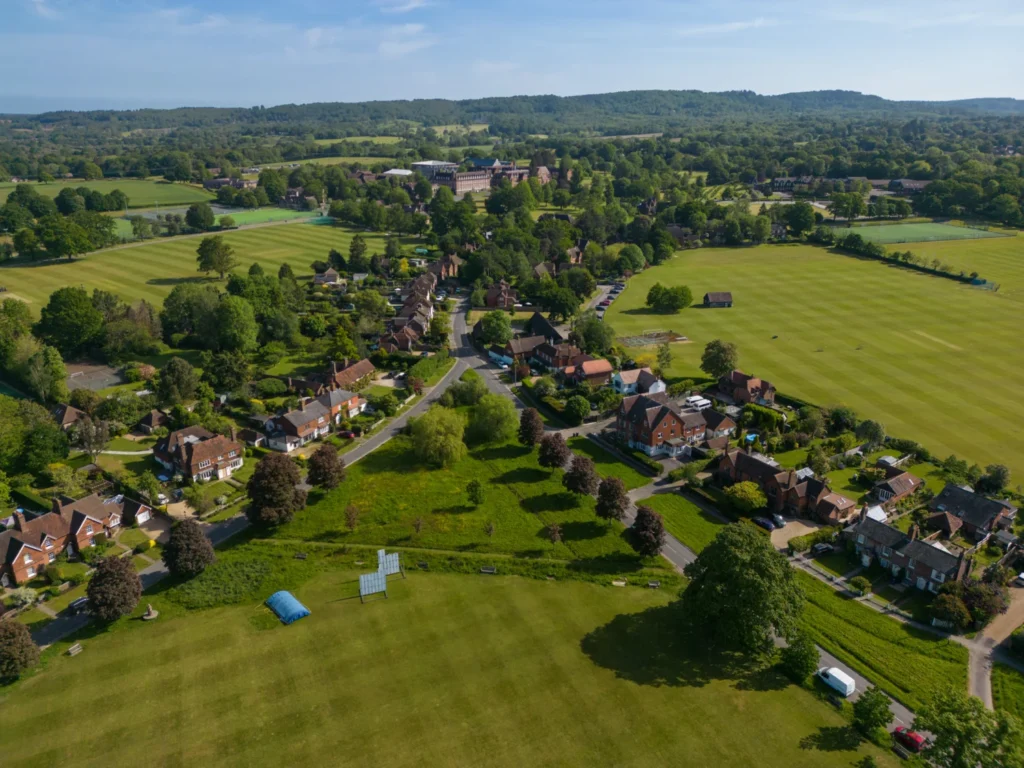
Buyers and renters are increasingly looking for space, access to the countryside, and a sense of community that city living often can’t offer. Villages that once felt like a compromise are now, for many people, the preference. That sustained demand doesn’t go unnoticed by developers.
Planning Pressure Is Pushing Outward Too
It’s not just buyer sentiment driving this shift. Local authorities across England are under sustained pressure to hit housing targets, and in many towns and cities, the obvious land has already been built out, is constrained by infrastructure, or simply doesn’t stack up financially.
That pushes attention outward: to edge-of-village sites, infill plots within existing settlements, and land on the strategic fringes of smaller towns. For landowners, this matters. Land that was quietly written off as agricultural or non-development a decade ago may now sit in a very different planning context.
The Strategic Land Opportunity
One of the most significant and most misunderstood opportunities in rural property lies in strategic land. This is land without current planning permission but with credible future potential: sites that can be promoted through the planning system, sometimes over several years, toward a point where consent becomes achievable.
Developers who understand this market are actively seeking out opportunities early. They’re securing options, building relationships with landowners, and taking a long-term view on value. For a landowner willing to take the same approach, the rewards can be substantially greater than an outright sale at agricultural value.
Getting this right requires proper assessment, though. Not every field is a development site, and knowing when land has genuine potential, rather than just hoping it might, is where experienced guidance makes a real difference.
The Value Isn't Always Obvious From the Outside
Rural land is routinely undervalued because its potential isn’t visible on the surface. A field that’s grown crops for thirty years doesn’t announce itself as a future housing site. But given the right location, the right local need, and the right moment in the planning cycle, that same field could sit within a future development boundary, support a small residential scheme, or form part of something larger.
At CPA Property, we work regularly with landowners who had no idea what they were sitting on. Not because they weren’t savvy, but because this kind of assessment requires knowledge of planning policy, local authority strategies, and market dynamics that most people simply don’t have cause to develop.
Developers Are Approaching This Differently Now
The stereotype of the developer chasing ever-larger urban sites is increasingly outdated. Many of the most active players in today’s market are specifically looking for smaller, well-located village schemes: sites with strong local demand, less competition from other developers, and a more straightforward path through planning.
Village developments can offer faster sales rates and genuine buyer appetite. The end product tends to be more appealing too, with lower density, more character, and better integration with an existing community. For the right developer, that’s not a consolation prize. It’s the preference.
Connectivity Has Removed the Old Objections
One of the traditional arguments against rural development was that villages are simply too isolated for most buyers. That argument has weakened considerably. Improved road and rail links, near-universal broadband coverage, and growing investment in local infrastructure mean that many villages are now genuinely well-connected. The trade-off between rural living and practical convenience has narrowed significantly, and that feeds directly into both planning viability and commercial demand
What This Means If You Own Land
If you own land in or around a village, whether it’s a paddock, a field, a larger agricultural holding, or simply a plot you’ve held for years, the honest question to ask yourself is this: has the potential of this land changed?
Planning policy isn’t static. Local housing needs shift. What wasn’t viable five or ten years ago may be worth serious consideration now. Previous rejection isn’t necessarily a ceiling. It’s a snapshot of a policy environment that may no longer apply.
The worst outcome is sitting on land with genuine value and never knowing it.
At CPA Property, we work with private landowners, developers, and investors to assess land potential properly: not speculatively, but strategically. If you’d like an honest conversation about what your land might be worth, or what options you haven’t yet explored, we’re easy to reach.
- Call Us: +44 (0) 1798 831250
- Email Us: info@cpaproperty.co.uk
Want to know how CPA Property can help you?
Whether you are buying, selling, letting or renting or perhaps just need some advice… We would love to hear from you.